Most people judge a lock by picking it up. If it feels heavy, it must be good. That instinct is not completely wrong, but it is the reason so many homes end up with a hefty lock screwed into a weak frame, which is a bit like fitting a bank vault door to a cardboard wall. A strong lock for home is really a small system, and the weight in your palm is only one part of it.
Here is how to think about strength piece by piece, and then how much of it each room in the house actually needs.
The body is where strength starts
The lock body is the casing that holds everything together. A solid body made from a good grade of brass or steel resists being bent, hammered or prised open. A thin pressed body, or one made from a brittle alloy, can crack if someone puts a crowbar between the door and the frame.
Zinc alloy bodies are common because they are cheaper to cast into detailed shapes. They work fine on interior doors. For the main door, though, we would always lean towards brass or steel. They take impact better and they do not snap the way a brittle casting can.
Look at the faceplate too, the metal strip you see on the edge of the door. A thicker faceplate, fixed with long screws, spreads force across more of the door edge.
Bolt throw and why a few extra millimetres matter
The bolt throw is how far the bolt shoots out of the lock into the frame. A short throw only just clears the gap between door and frame, so a bit of force can spring the door. A longer throw goes deeper into the frame and is much harder to defeat.
Many good main door locks have a double throw, where turning the key twice pushes the bolt further out each time. It is worth getting into the habit of turning the key fully every night. A double throw lock left on a single turn gives you half its strength.
The bolt itself should be solid, not a hollow shell. Some heavier locks use more than one bolt, which shares the load across several points on the frame.
Levers and the high security door lock question
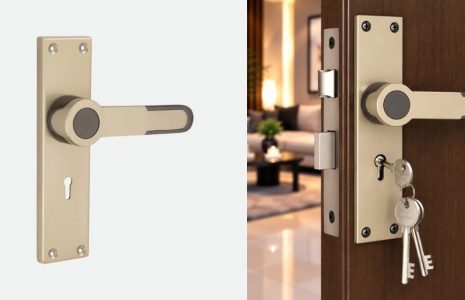
Inside a mechanical lock, levers are the small plates that the key has to lift to exactly the right height before the bolt can move. More levers mean more combinations and a lock that is harder to pick. That is why a 6 lever or 7 lever lock is generally preferred for main doors over a 3 lever one used for an inside room.
A high security door lock usually adds more on top of that. Hardened parts that resist drilling, keys that are difficult to copy at a roadside key shop, and anti-pick features inside. Smart door locks add another layer, with codes, fingerprints and alerts, though they still rely on a strong mechanical bolt underneath.
Levers matter, but people sometimes over-focus on the number. A many-lever lock with a short bolt and a flimsy body is still a weak lock.
The strike plate is the part nobody checks
When someone kicks a door, the lock rarely breaks. What usually gives way is the frame around the strike plate, the metal plate on the frame that the bolt slides into. If that plate is held by two short screws into soft wood, the whole frame edge splits and the door swings open with the lock still locked.
The fix is simple and cheap. Use a sturdy strike plate and fix it with screws long enough to reach deep into the frame. On a wooden frame this one detail adds more real strength than upgrading the lock itself.
Main door lock strength depends on the door frame
A door is only as strong as what it is hung on. A solid hardwood frame, a steel frame or a well fixed concrete surround gives the lock something to hold. A hollow flush door on a thin frame cannot, whatever lock you fit.
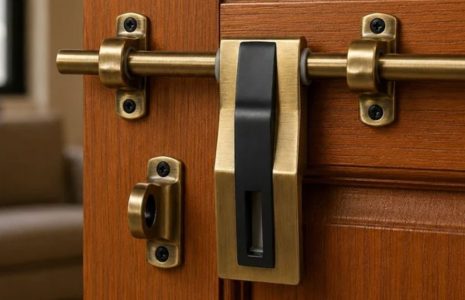
Hinges count as well. If the hinges are on the outside and their pins can be knocked out, the door can be lifted off from the hinge side. Strong butt hinges with good screws, and a tower bolt at the top and bottom on the inside, close that weak spot. For double doors, the passive leaf needs its own bolts into the floor and the top of the frame, otherwise both leaves can be pushed in together.
Choosing a strong lock for home, room by room
Not every door needs the same lock, and spending equally on all of them wastes money where it is not needed.
- Main door and gate. This is where the strongest lock goes. Solid body, long double throw bolt, more levers, a good strike plate, and a supporting aldrop or tower bolts.
- Back door or terrace door. Often forgotten, often the actual entry point for a break-in. Treat it close to the main door.
- Bedrooms. Privacy matters more than force here. A mortise handle lock with a key is enough.
- Bathrooms. A privacy lock that can be opened from outside in an emergency is safer than a heavy lock.
- Almirahs, drawers and the study. A good cabinet or drawer lock keeps documents and jewellery away from casual hands.
That spread gives you serious strength where a thief would try, and comfortable everyday hardware everywhere else.
Also read
Talk to Atom Locks
Atom Locks has been making locks and door hardware in Aligarh since 2002, from main door and double door locks to smart door locks, padlocks, aldrops and tower bolts. Browse the full range on www.atomlocks.com or shop directly at shop.atomlocks.com. If you are a builder or contractor securing a full project, the Bulk Query form on the website is the quickest route. You can also call +91 9412273735 or email sa***@*******ks.com to talk through what your doors need.